Solutions for festivals and concerts
Multi-stage technical production for large-scale music events.
What we do differently on a festival
This format does not forgive logistical vagueness. Three things get settled on paper before they get settled on the ground.
The site plan is drawn before it is walked
Stage positions, orientations, audience zones, cable routes and truck access on one drawing. That document settles the conflicts between suppliers, not the conversation on the morning of.
The patch is frozen before the artists arrive
A shared patch sheet, distributed to touring engineers in advance. Whatever turns up outside it goes onto channels deliberately left free, never by moving what is already there.
We plan for the failure, not just the build
Redundancy on whatever stops the show: power, main console, the link between control and stage. The rest gets repaired while the music plays.
What we bring in most often, and why

Audiovisual production
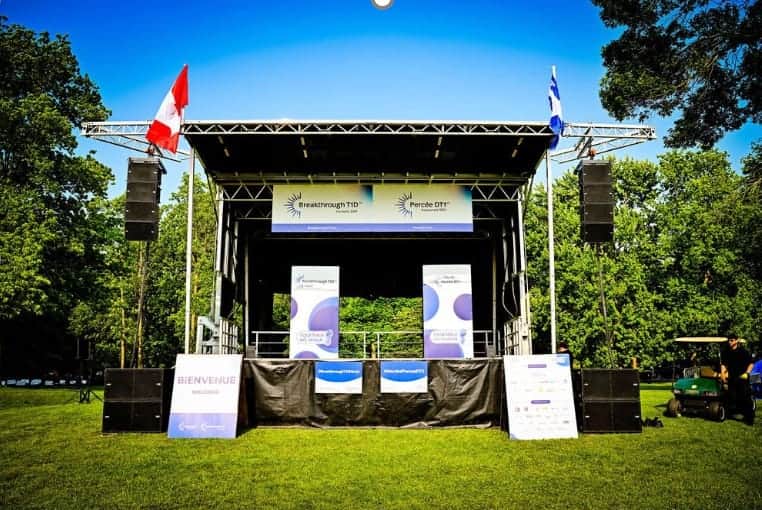
A festival needs sound that carries without crushing the neighbours, light that still exists at nine in the evening in June, and an image that holds up in daylight. All three constrain each other and get decided in the same meeting.
Rigging and staging
An outdoor structure is a load-bearing work exposed to wind, not a set. Loads, anchoring and the evacuation threshold get calculated and signed, and that is what separates a stage from an assembly of truss.
Technical direction
Three stages, forty acts and six suppliers who have never worked together. One person holds the site plan, the build schedule and the last-minute calls, or each optimises their own corner and the site never closes on time.
What an outdoor stage needs
Browse the catalogueA system sized on the throw required and on the level permitted at the perimeter, two constraints pulling in opposite directions. Delay fills rather than a pushed main hang, and a backup console already loaded with the same files.
Outdoor lighting only starts to exist after dark, so the early hours are carried by the set and the screen. Fixtures rated for rain, and a work circuit that stays lit for the strike.
Truss, hoists and anchoring sized on real loads plus the wind area of the covers, which often weighs more than the equipment. Every pick point is documented, and harnesses are inspected before each build.
Generators sized with real headroom rather than to the exact calculation, distribution split between sound, light and services, and earthing verified with an instrument. A cut on the main stage stops the festival, not one act.