
Solutions for hybrid and virtual events
The best of both worlds to maximize your reach.
What we do differently for a hybrid event
The remote audience is the fragile one. Three choices keep it to the end.
We build the sound before the picture
Budget goes to audio capture first: individual microphones rather than a room mic, a direct feed off the console, and monitoring on the final mix rather than in the room.
Someone works only for the online audience
One person follows the chat, brings questions forward, flags a stream problem. That role is never a second hat, or it disappears the moment the room asks for something.
The stream has a run of show of its own
Breaks, transitions and dead time in the room get filled on the stream by a card, a package or a host segment. A black screen is a disconnection.
What we bring in most often, and why

Audiovisual production
A hybrid event needs a live cut, clean audio capture and a room image at the same time. Splitting those crafts puts delay between sound and picture, and two frames of drift is noticed remotely long before it is noticed in the room.
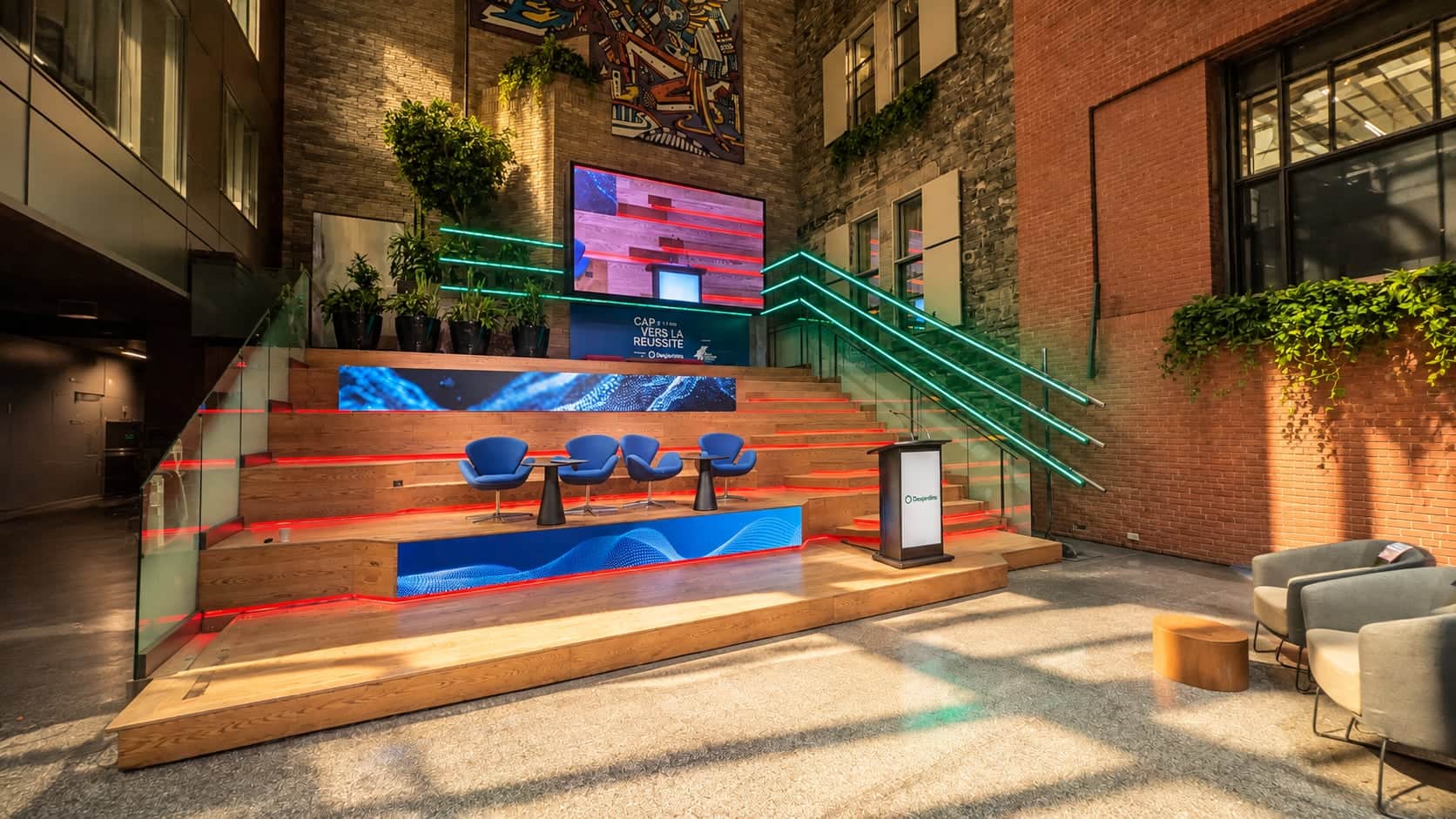
Collaboration rooms
An organisation broadcasting every month ends up paying for the same setup every time. A room fitted once gives constant quality, no preparation time and meetings that start when they are supposed to.

Technical support
A live broadcast has no second take and it degrades silently: nobody in the room sees that the stream has dropped. Someone has to be watching the output rather than the stage, start to finish.
What a live broadcast needs
Browse the catalogueTwo cameras minimum, one wide and one tight, so the cut has something to work with. A single forty-minute shot is the leading cause of drop-off, ahead of image quality itself.
Individual microphones on everyone who speaks, never a room mic: that is what separates a capture people listen to from one they close. The stream mix is distinct from the room mix.
A dedicated uplink, measured under load before the event, with a backup that fails over without intervention. The venue guest network serves the audience, never the broadcast.
Neutral face light is enough and is almost always missing. A room lit for comfort gives grey speakers on camera, and it is the cheapest adjustment with the biggest effect on the result.